Now

From scribble to dribble: how Chicken Scratch got made

Chicken Scratch / November 26, 2026
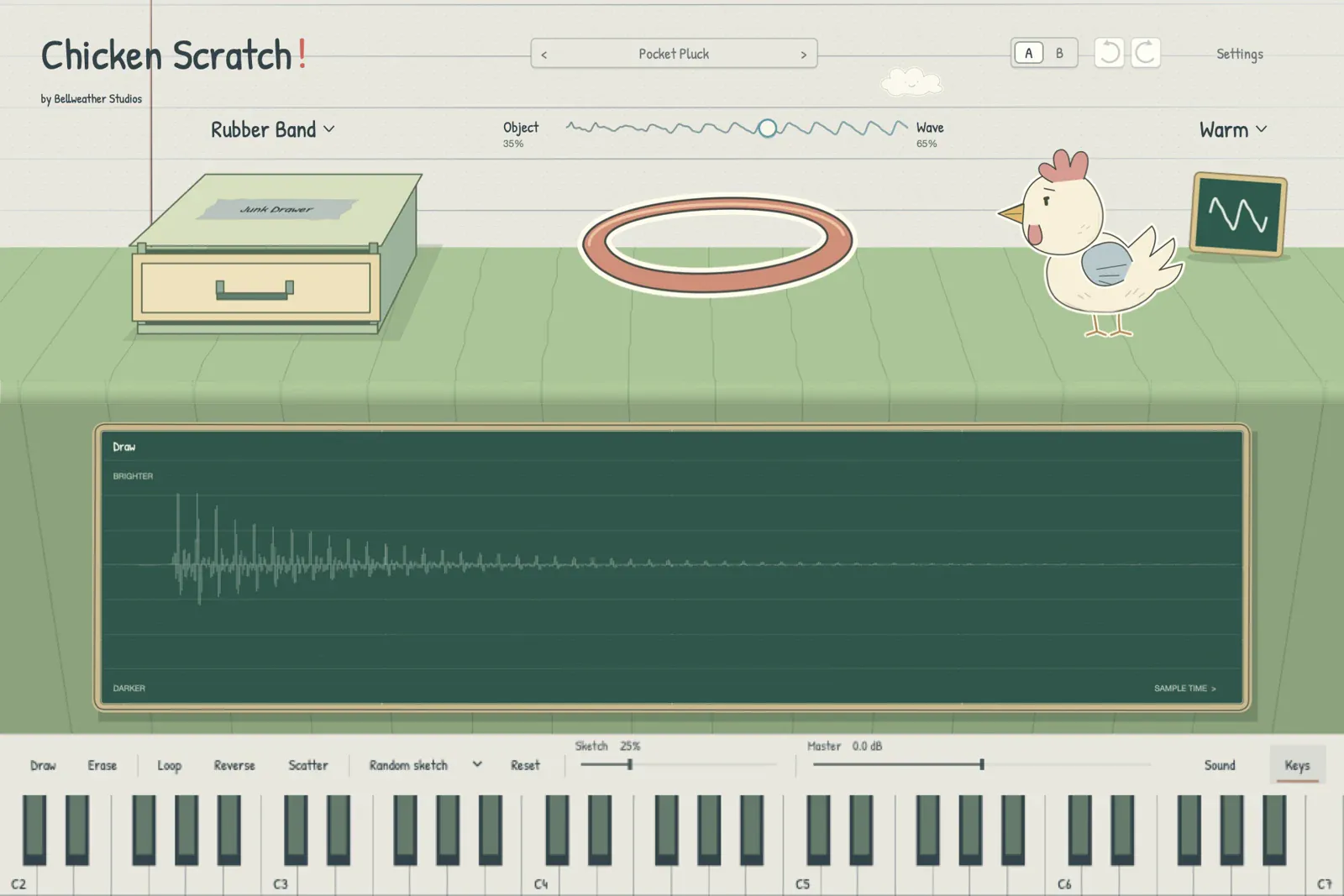
The Chicken Scratch window with a junk drawer, a rubber band, a chicken, a small slate and a chalkboard
spoiler: this is where it lands.

November 12: a sketchbook that makes noise. Thanksgiving: version 1.0.0. In between: a lot of quick ideas, most of them tried before anybody built a thing, and plenty of them coming back no.

day one

Draw something, hear it. By bedtime it had paper parts that moved on their own, motion that followed the notes, a junk drawer with its own artwork and a pile of sketches. Day two, the steady synth voice and the scribbled recording got separated, so your chord could stay in tune while the junk did junk things.

employee of the month.

brakes

About a week in, testing and packaging had run ahead of a thing that wasn't an instrument yet. Verdict: no. Make it good first. Then came the effects: cards you can drag, each family made of its own material, so you know who's who without reading.
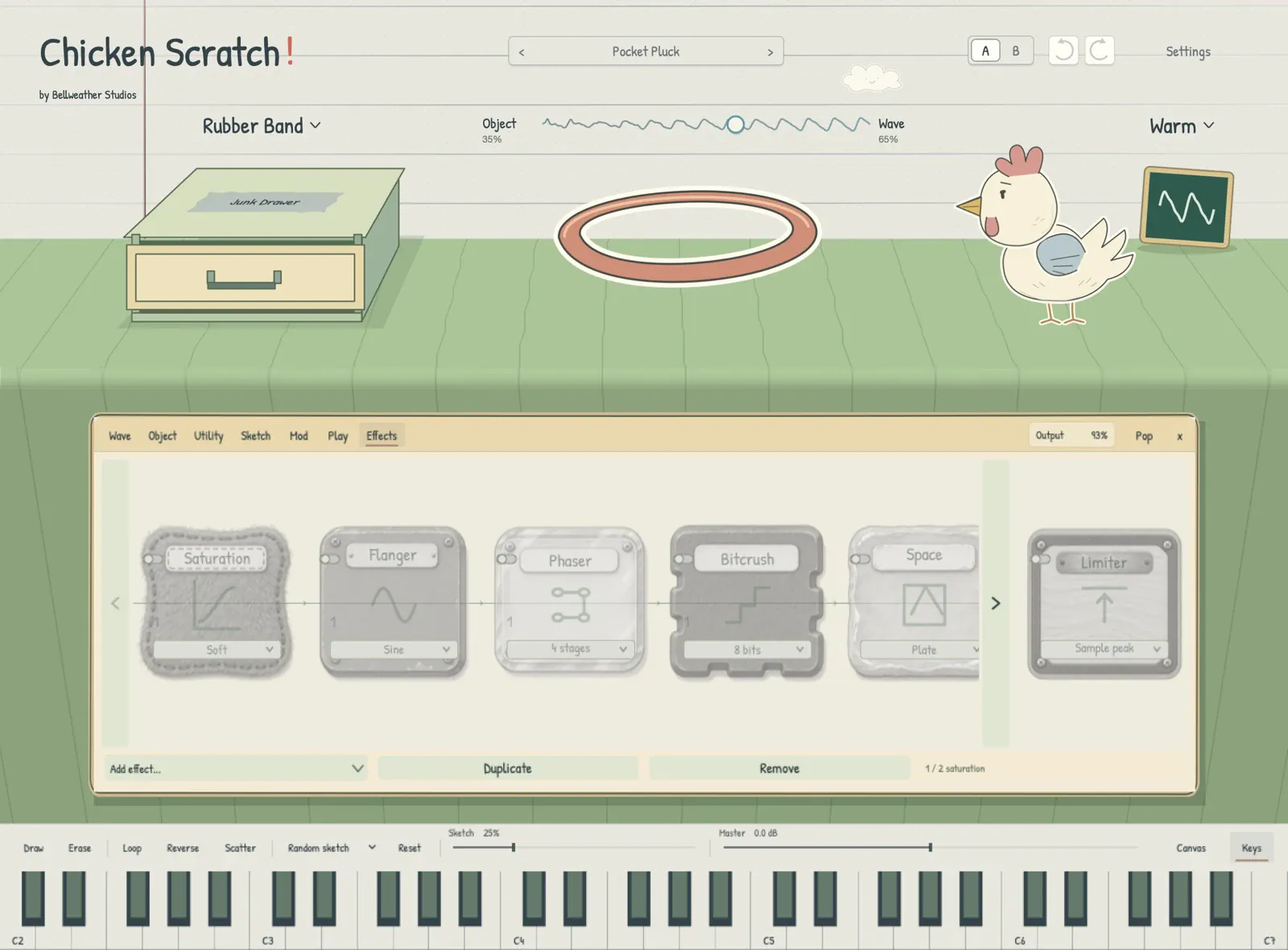
A row of effect cards
touch the cards.

naaaa bruh

No full build to find out something looks wrong. Ideas go up in the dev browser first: sketch it, poke it, change it, look again, in minutes. What survives gets built into the real plugin. What doesn't never costs a build.

The scrollbar: no. A grip in the middle of the header: no. A layout that looked so calm in the mockup and not at all in the plugin: naaaa.
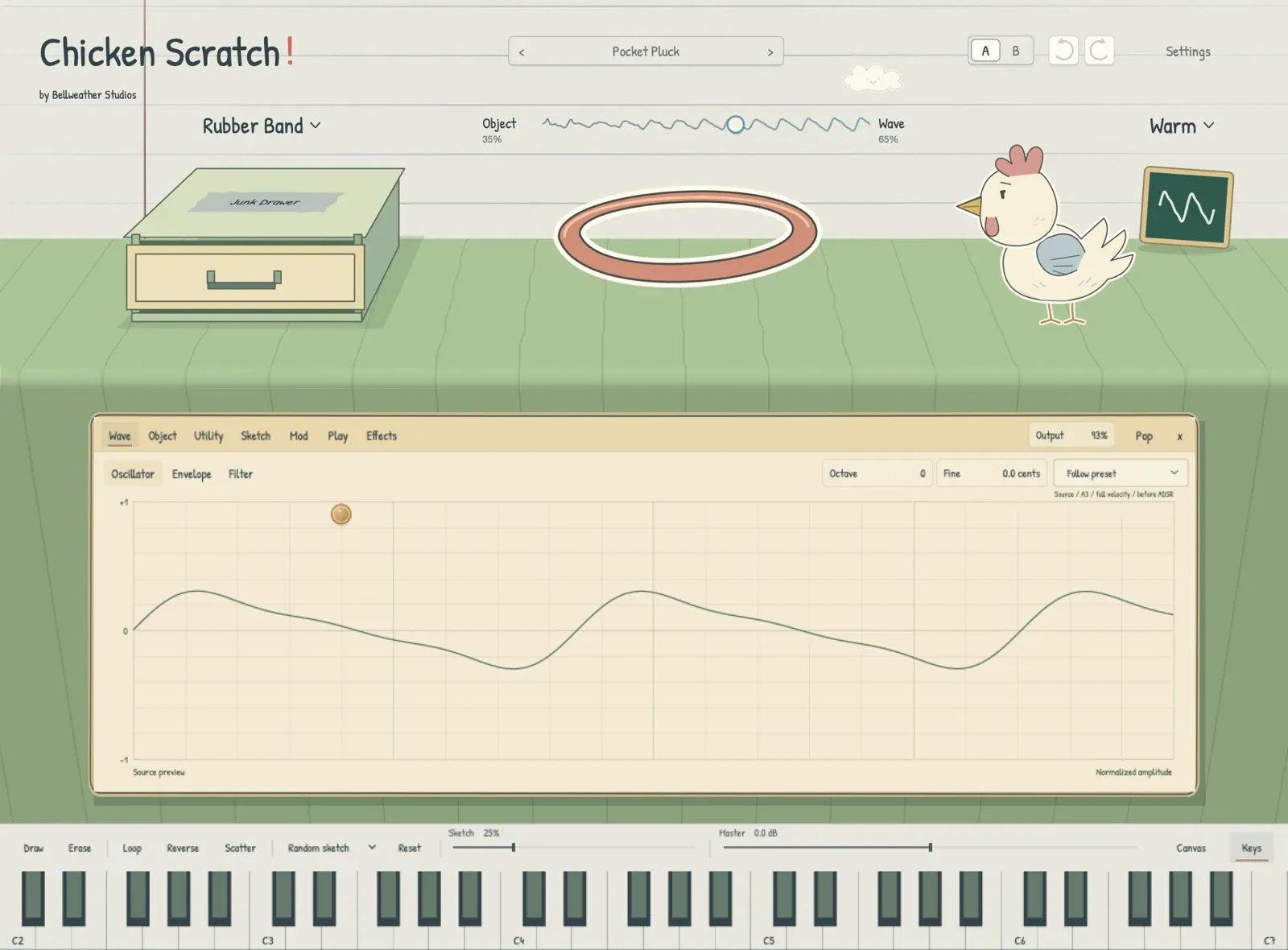
The Sound panel showing the wave
under the table.

Then two sounds you can flip between, more presets, all level matched, and a safety stage at the end so a rowdy patch never leaves the plugin at full scale.
The B button, undo, redo and Settings
keep the good one.

then it got played

The quick loop is for looks. Installing it and playing it finds the rest, and it found what testing didn't. The preset arrows stopped dead at the end of a group. "Body" meant nothing. The synth had nowhere to sit. Body became Wave, and after a parade of quick mockups, some laid right over screenshots of the real window, a little slate behind the chicken took the job.

wax on.

The slider became a line drawn from the sounds. First attempt morphed the wrong way. It also held on to an old picture when two recordings shared a name. Both fixed.

from junk to wave.

two clicks, one bird

The whole scene runs as one sequence. One clock, one thing deciding what moves when, so the drawer and the slate never talk over each other. Click the drawer, then the slate before the bird is back: it finishes the first job and goes straight into the second, from wherever it's standing. No teleporting.

Same loop here: run it, film it, watch it, fix the beat that felt off.

multitasking, technically not.

"we crossed into sloppy"

That's from my own notes. Buttons stayed lit. No tooltips. The slate sounded like it lived in a cathedral. No icon. Settings was a mess. All fixed, and you can now Option-drag a whole drawing around.
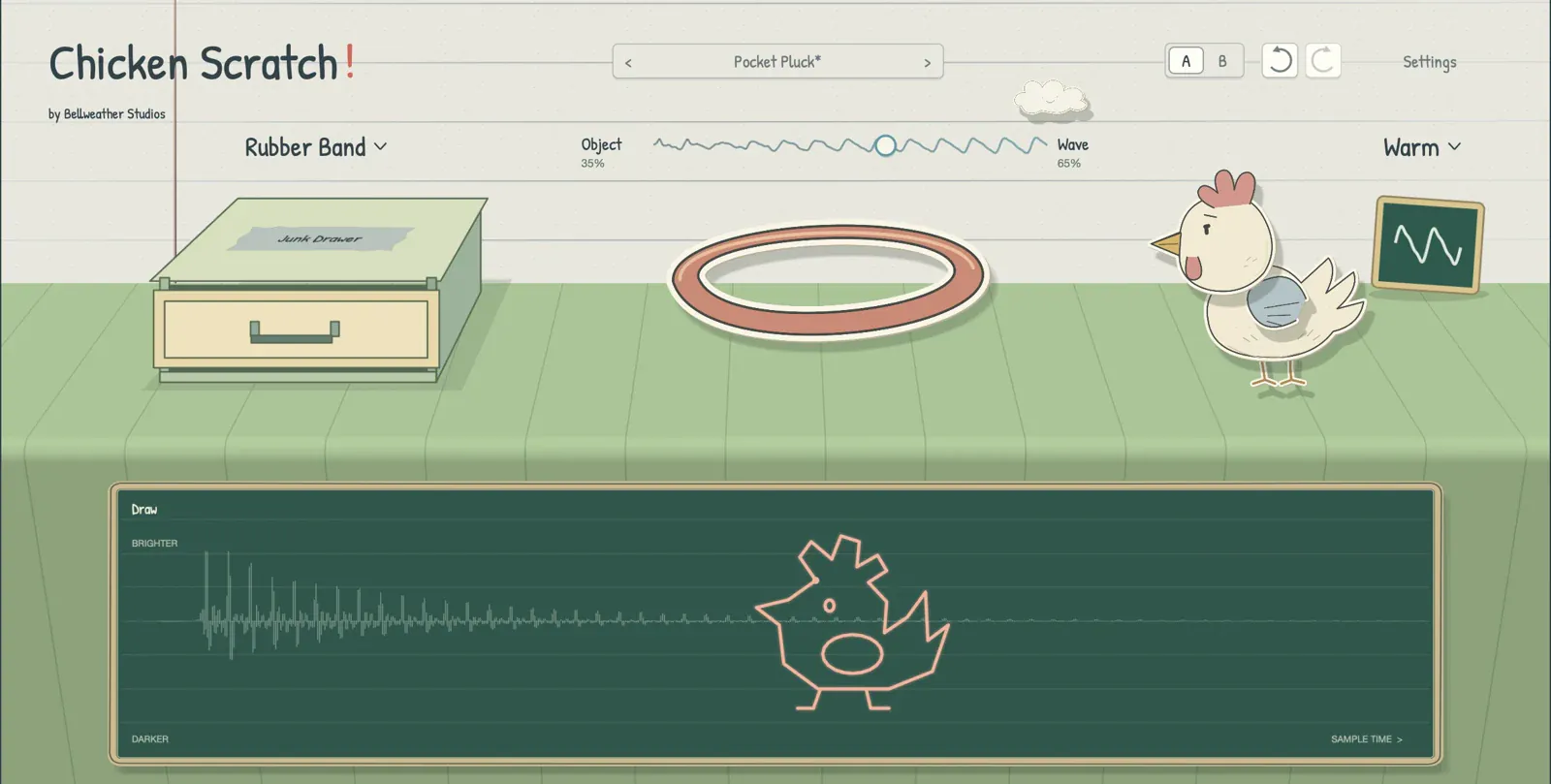
A chicken drawn in chalk on the chalkboard
self portrait, allegedly.

Then we tried to break it on purpose. A save question was hiding under the artwork, so the window looked frozen. A badly built preset folder could hang or crash the host. A failed save said absolutely nothing. All three found by running the real thing.

gobble

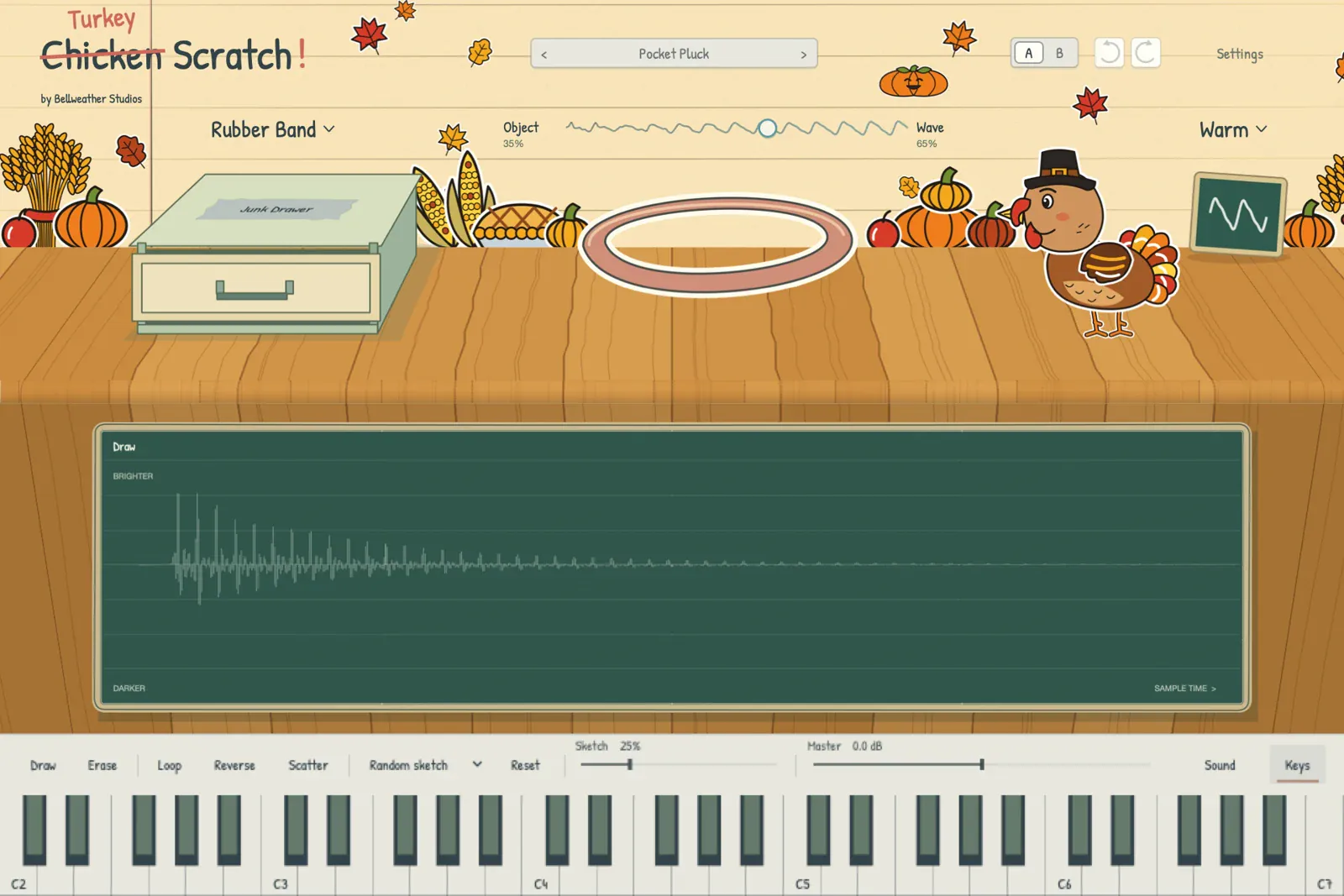
It was Thanksgiving. The chicken dressed for it and learned a new word.

go on, poke it.

and out the door

AAX showed up on the last day. The first signed installer brought hidden stowaways. Slimming the binaries broke the checks that read them. Fixed, signed, notarized, opened, saved and reopened in two DAWs.

Started with a chicken and a chalkboard. Ended with a gobble.
Junk drawer? Make it a feature.

Chicken Scratch / November 26, 2026

Chicken Scratch in its Thanksgiving look, with a turkey beside the table
overdressed, on purpose.

One day, I had to sign for something. The person looked at my signature, then said "Looks like chicken scratch."

Rude. Accurate. Also an idea.

the drawer

You all know the drawer. Rubber band, paper clip, ruler, coin, tape dispenser, stuff nobody can explain. Click it. For some reason a chicken goes and grabs something. THIS IS A REAL JOB MOM SO LET IT TAKE IT SERIOUSLY.

delivery.

scribble, play

Draw a line on the chalkboard. Hit a key. The note follows your line through the recording: high is brighter, low is darker. Put the synth wave under it and the notes stay in tune while the junk carries on being junk.

the finest of art

don't let the cartoon fool you

Envelopes, LFOs, mono and legato, an effects rack, undo, your own presets. All under the table. The chicken is the front door.

turckin?

Thanksgiving launch so lets be festiveeee

The same bird dressed as a turkey, with pumpkins
The everyday chicken beside its small slate
same bird. bigger personality.

how much

Nothing. Mac, as its own app or as an Audio Unit, VST3 or AAX. If you had a good time, there's a tip jar. No perks, no strings, nothing but guilt from the user who's taking advantage of a poor ol' chicken.

Teaching a chicken to wipe...a chalkboard?

Chicken Scratch / November 26, 2026

wiping.

The recording had everything: a drawer, a spot on the table, a chicken to fetch it. The synth had a word in a corner.

One of them you could poke. The other was paperwork.

wavyyyy

The synth layer is Wave. Because look at it. It's a wave. It gets its own little slate with its name on top, and the thing on the table stays the Object, because there is an actual object sitting there.

stfu

A chalk sign. A speech bubble. A whole board behind the object. Everybody talking at once. Less. The table only works when things can breathe, so one small slate behind the chicken won, and everything else was told to hush. Click it. Watch the labor.

a line that shapeshifts

The slider between the two layers is drawn from the sounds themselves. Slide it and your junk turns into your wave. Our first try did it backwards, which honestly takes talent.

junk in, wave out.

the sneaky one

Swap in a new recording with the same name and the slider kept the old picture. It was reading the label, not the contents. Fixed. There's a test now that tries that exact trick.

winner winner chicken (ain't) dinner

Nothing the chicken does is freestyle. The whole timeline is one sequence, tightly defined and controlled. One clock runs the scene and one thing decides what happens when: hop round, step up, wipe, chalk the new wave, hop back. The sound changes at exactly one moment, as the wiping ends and the drawing begins.

The drawer plays by the same rules, so the two jobs never trample each other. Every pose eases into the next, so the bird never teleports. The tests stop the clock and step it by hand, so a busy machine can't fake a pass.

And the chicken is the one holding it together. Click while it's busy and it finishes what it's doing, then goes back for the next thing. A stalled frame can't make it skip the part that counts. Prefer a calmer bird? Reduced motion makes changes happen at once.

Pressure 1.9.0: Five Voices, Three Views

Pressure / October 31, 2026

One Instrument, Five Voices

Pressure 1.9.0 brings its five voices into three focused views: Compression, Metering, and Sidechain. Shared controls keep the core compression decision close while each view provides a different level of detail.

Move between Mix, Instruments, Vocals, Drums, and Master to find the response that fits the material. Each voice has its own visual identity; the shared controls keep comparison and adjustment familiar.

What Changed

Five engine-specific water objects with dedicated Compression, Metering, and Sidechain views.

Revised Mix, Vocals, and Drums response profiles, with the other voices retaining their distinct behavior.

Independent Output attenuation after automatic gain compensation for Vocals and Drums in Manual mode.

Choose The View For The Decision

Compression: An engine-specific water visualization keeps compression activity in view alongside the main controls.

Metering: Inspect the transfer curve, gain-reduction history, and input/output levels when you need a closer look.

Sidechain: Inspect and shape the detector signal with the sidechain controls and analyzer.

Evidence With A Version Attached

The retained universal macOS candidate passed pluginval, auval, AAX Validator, and CLAP Validator checks.

Code-signature and universal-binary checks passed for all four formats. Apple notarization and stapling passed, and AAX PACE signing completed.

The signed macOS installer and archive are bound to the tested candidate through recorded artifact hashes.

These results cover the named macOS candidate and package checks. They do not establish every DAW journey, Windows qualification, public download availability, or new measurements for the historical audio-characterization tables below.

The research notes retain earlier audio measurements with their original version and conditions. A new interface or package does not turn an old measurement into a new result.

Updating

Check Weather Station or your account for the version and formats available for your operating system. The manual documents the 1.9.0 interface; availability follows the published release catalog.

Bellweather Audio Attest Is Public Source

Platform / July 8, 2026

Bellweather Audio Attest makes the proof side public.

That distinction is important to me because source code and evidence are related, but they are not the same thing. A source release says, here is how this part is built. A proof release says, here is how a render can be blessed, signed, checked later, and made answerable in a way that does not depend on somebody remembering what sounded right last Tuesday.

Audio Attest is a headless C++ proof layer for rendered WAV files: bless a known-good render into a signed reference, then verify later renders against that reference in CI.

It sits near Bellweather Audio Core because both releases care about inspectable audio evidence, but Attest has its own job: make rendered output accountable over time.

Why this needed its own repo

It would have been easy to bury this work inside a broader testing suite and call it internal infrastructure. That would have made the system convenient, but less legible. Audio Attest deserved its own public shape because the idea is narrower than Bellweather as a whole and more specific than generic validation language.

The repo is about one thing: proving that rendered audio still matches a blessed baseline across the detector lanes Bellweather cares about. It does not host plugins. It does not load DAW sessions. It does not judge whether a mix is good. It compares rendered audio against a signed reference and makes that comparison inspectable.

That narrowness is the point. The more specific the claim, the easier it is to hold the release accountable.

What signed reference actually means here

The workflow starts with a known-good render. Audio Attest mints that render into a signed reference using a DSSE envelope and a VSA-style predicate over the detector baseline. Later, a candidate render can be checked against that reference with a public key.

That sounds more ceremonial than it is. The ceremony exists because audio regressions are slippery. If a baseline is just a loose file on disk, it is too easy for the reference and the candidate to drift together. If the reference is signed, the release process has a harder object to reason about.

This is not a claim that every audio question can be solved cryptographically. Taste cannot be signed. Musical judgment cannot be reduced to a hash. But the narrow question of whether a rendered output changed from a blessed reference can be made much more disciplined than a folder full of unnamed WAVs.

Not a plugin host

The boundary matters enough to say plainly. Audio Attest is not a replacement for a DAW, a plugin host, a product installer, a licensing system, or a release manager. It validates audio that something else already rendered.

That separation keeps the tool honest. Plugin hosting is its own problem. DAW session reproduction is its own problem. Product distribution is its own problem. Audio Attest does not pretend to own those layers. It owns the signed-reference proof around the rendered artifact.

That makes it useful in a release pipeline without turning it into the whole pipeline.

The public shape

Included: the bpts CLI, signed bless and verify workflows, unsigned compare and scan diagnostics, detector lanes for loudness, THD, aliasing, stereo, spectral masks, and numeric hygiene, plus Docker and sanitizer lanes.

Not included: plugin binaries, DAW hosting, private signing keys, installers, licensing services, update infrastructure, or a promise that detector output replaces listening.

Why Barometer is still the case study

Barometer remains the right reference case because it sits at the overlap between the two public-source releases. Audio Core publishes the reusable metering code and the source-built Barometer reference stack. Audio Attest publishes a way to bless and verify rendered output from that world.

That does not make Barometer the product being downloaded from Audio Attest. It makes Barometer a concrete subject for proof. The same reason it helped Audio Core avoid being a diagram also helps Audio Attest avoid being a generic cryptography demo.

A proof tool needs an artifact to prove against. Barometer gives the public release a small, license-clean, source-built thing to point at without turning the repo into the Bellweather product platform.

Why detector lanes are not vibes

A vague audio-regression claim is easy to make and hard to trust. Audio Attest keeps the checks explicit: loudness, true peak, loudness range, harmonic distortion, aliasing, stereo correlation and width, spectral masks, numeric hygiene, and related baseline comparisons.

None of those detectors can tell you whether a record feels finished. That is not their job. Their job is to make specific classes of drift visible when a render changes. If a nonlinear path starts aliasing differently, if loudness behavior moves, if stereo behavior shifts, or if a render starts producing invalid numeric output, the proof layer should have something concrete to say.

The value is not that the detector list sounds impressive. The value is that each lane names the kind of evidence it owns.

How it fits with Audio Core

Audio Core and Audio Attest are deliberately different shapes. Core is a source library with a reference plugin. Attest is a headless proof layer for rendered output. One is about reusable audio code. The other is about signed evidence over what that code eventually produces.

Together, they are a more honest public story than either would be alone. Source without proof can become a pile of claims. Proof without source can become a black box. The pair gives Bellweather a public way to say: here is the code we are willing to show, and here is the proof discipline we are willing to show around rendered audio.

That is also why the two landing pages now mirror each other visually. They are not the same repo, and they should not pretend to be. But they should feel like two sides of the same release posture.

So this is the companion note to Audio Core. Same bet, different side of the table: whatever good means now, it probably has to include source you can inspect, evidence you can run, and boundaries plain enough that nobody has to decode the posture from vibes.

Bellweather Audio Core Is Public Source

Platform / June 21, 2026

Open source hits different in the age of AI. Code is cheap now - a person can ask for almost anything and receive something that compiles, something that looks plausible, and something that's "good enough" to move on from.

To me, that changes the question entirely. If anyone can make "more code," what does it even mean to make "good code?" Does "good" even matter? Is it even relevant? "Good enough" has always been a metric outside of AI, so now that AI is here, is that the metric everyone has been trained to expect, the rule or the exception?

Bellweather Audio Core is my way of sitting with that question in public. Sure it's an open-source C++ audio-core release, but it's more a timestamp than anything: a snapshot of how I (Bellweather) am thinking about quality, proof (does the code/product actually do what I want it to do), taste, and reusable audio infrastructure right now, in the AI space.

I think of this in the same way I write and produce songs. Writing and getting a song to work is the BARE MINIMUM. The question is, and has always been, what's the final product? Does it have the right vibe? Does it do justice to the song itself? Is the artist being represented truthfully, honestly, and to the best of their ability in that moment? That is what I am trying to capture here. The code is the minimum, but the public shape, the runnable proof, and the visible boundaries are all part of the release because they are part of how I want to talk about quality in this moment.

For the love of the game

This is not "open source as a growth funnel," nor is it some claim that this is "the audio library the world needed" - it is closer to a public notebook. If the work is visible, I have to be accountable to it and sit with it long enough to see whether it holds water.

That part matters...because as they say, "embarrassment is the most under-explored emotion," and if someone can overcome THAT awkwardness, then they just gained the wildest superpower. Tech is SOOO urgent, self-righteous, and serious that there is rarely time to sit with an idea until it matures. Bellweather Audio Core is my attempt to chill tf out on the instant-disposal cycle for one narrow piece of the work. Put it somewhere public. Make the claims runnable. Let future-me look back and laugh, wince, or learn.

I don't know exactly what this will become or where it will go - all I know is this is a record of where my thinking was in 2026. That is enough of a reason to publish it.

Not a product download

That distinction matters enough to say plainly. Bellweather Audio Core is not a prebuilt Barometer download. It does not ship installers, signing artifacts, notarized packages, licensing services, update services, or unreleased product DSP. Those belong to the product and delivery systems around Bellweather's commercial work.

The public release is useful for a different reason. It gives C++ audio developers a readable, buildable source tree for the pieces that can stand on their own: metering, DSP primitives, audio types, ports, FFT support, and RT-safe infrastructure. Barometer is included as source-built JUCE reference code so the architecture is not presented as a diagram with no real integration behind it.

The public shape

Included: framework-neutral audio libraries, public-surface checks, standards-oriented metering tests, and the Barometer source closure needed to exercise the JUCE adapter boundary.

Not included: prebuilt plugin binaries, installers, signing, notarization, licensing services, update infrastructure, unreleased product code, or the full Bellweather product/delivery system.

Why Barometer is in the repo

A framework boundary is easy to claim and harder to make visible. If the repo only contained small isolated modules, it would be clean but less instructive. If it contained the full product system, it would be broad but less honest about what is actually reusable.

Barometer gives the release a middle path. It shows the reusable core adapted into a JUCE plugin while keeping JUCE at the edge where it belongs. In that shape, the reference build does not turn the source release into a product download. It makes the adapter boundary answerable.

The proof has to be runnable

Audio metering is a poor place for vague confidence. LUFS, true-peak, loudness range, sample-rate behavior, and real-time processing constraints all have to survive contact with repeatable checks. Otherwise the public claim is only a paragraph with a professional vocabulary.

That is why the release includes standards-oriented metering tests and downstream-consumer public-surface checks. The goal is not to make the repo look complicated. The goal is to let a reader move from claim to source to build to test without needing to trust Bellweather's tone of voice.

The shortest native path is the library preset: clone the repo, run cmake --preset library, cmake --build --preset library, then ctest --test-dir build-library --output-on-failure. The landing page exposes those commands as copyable reference blocks, including split lanes for public-surface, metering-conformance, JUCE-separation, and Docker proof.

Quality when success is not guaranteed

Spending more time on a project does not automatically make it successful. It does not guarantee adoption, usefulness, originality, or taste. The uncomfortable part is that spending less time does not automatically disqualify something either. We are living in that tension now.

So quality has to mean something more specific than effort. For this release, it means the public surface is narrow enough to inspect, the claims can be checked by someone else, and the exclusions are stated without trying to turn absence into mystery.

That is the standard I want this repo to be judged against: not whether it is the biggest possible thing, but whether it is honest about what it is, disciplined about what it is not, and useful enough that another developer can run it without needing the surrounding Bellweather machine.

Like I mentioned before, I don't have some "grand motif" for where this goes. Nonetheless, here we are: a small bet that whatever tf "good" is still matters, even when code is NEVER seen by the public & is easier to produce than ever before.

Five Voices, Measured: How Pressure's Compressor Engines Move Differently

Pressure / May 31, 2026

Version And Evidence Context

This article preserves its original research or testing-methodology context. Its measurements and historical findings are not a new Pressure 1.9.0 qualification result. The Pressure Research Notes distinguish retained 1.9.0 candidate checks from earlier audio measurements.

Five Voices Should Mean Five Behaviors

A compressor can present a row of modes and still leave a reasonable question unanswered: are those voices materially different, or are they mostly interface labels wrapped around small parameter changes? Pressure is built around five compressor voices, so that distinction matters. The voices should not merely read differently on a product page. They should react differently when audio moves through them.

We now have a reproducible lower-layer characterization snapshot for that question. Under the same controlled fixture, each Pressure voice exhibits its own attack, release, and recovery fingerprint. The result is not a ranking and it is not a claim that one timeline is universally better. It is evidence that the voices make genuinely different decisions over time.

What We Measured

The fixture isolates the compression core directly. It uses a repeatable level transition, tunes each voice to approximately 6 dB of raw gain reduction, and records when gain reduction reaches 10%, 50%, and 90% engagement. It then records the recovery path back through 90%, 50%, 10%, and 1%.

This is deliberately narrower than a listening demo or a full-plugin validation run. It does not include presets, AUTO-mode policy, lookahead, oversampling, flavor controls, a DAW host, or real program material. The narrowness is useful: by holding those variables still, the response shape of each compressor voice becomes easier to inspect honestly.

The Fingerprints Are Distinct

INST is the fastest voice in the snapshot, reaching 90% engagement in roughly 0.1 ms. That is the sound of assertive control: it reacts almost immediately when the signal arrives. MASTER reaches the same point in roughly 2.8 ms, while MIX and VOCALS land close to 12 ms. DRUMS takes roughly 20.3 ms, preserving a different relationship with the front edge of a transient.

The release paths separate just as clearly. MASTER recovers to the 10% point in roughly 338 ms. MIX takes roughly 481 ms, INST roughly 534 ms, and DRUMS roughly 593 ms. VOCALS takes roughly 5,704 ms, and its final 1% recovery crossing remained above the measurement floor after the 20-second observation window.

Different Is The Point

It would be easy to read a table of milliseconds as a race. That would be the wrong interpretation. A very fast response can be the right choice when a voice needs immediacy and bite. A longer recovery can be the right choice when a voice needs to level material smoothly instead of snapping back between phrases.

The useful conclusion is not that one voice wins. It is that the names correspond to measurable motion. MIX and VOCALS also show multi-stage release tails under the controlled observational heuristic, while the other three voices do not trigger that flag in this fixture. Those differences are part of the product's vocabulary.

What This Does Not Prove

Characterization becomes less trustworthy when a narrow measurement is promoted into a broad claim. This snapshot does not prove how every preset behaves on every source. It does not replace listening. It does not replace black-box plugin validation. It does not establish universal release thresholds or a single ideal compressor response.

Instead, it gives the public story a firmer floor. Pressure's voices are not cosmetic categories. Under controlled conditions, their timing behavior is independently observable and reproducible. The fixture conditions and caveats belong beside the numbers because evidence is more useful when its boundaries remain visible.

Why Reproducibility Matters For Future Refinement

The snapshot is also a guardrail for future DSP work. Improving transparency, smoothing, or detector behavior is not useful if the result quietly flattens the identities that make the five voices worth having. A repeatable baseline lets us compare a proposed change against the current implementation before deciding that the change is actually an improvement.

That is the deeper value of measurement here. It lets Pressure evolve without treating character as a vague memory. When the sound changes, we can ask a sharper question: did the refinement remove an unwanted artifact, preserve the intended fingerprint, or accidentally make distinct voices behave more alike?

Pressure Release Readiness Playbook

Observatory / February 24, 2026

Version And Evidence Context

This article preserves its original research or testing-methodology context. Its measurements and historical findings are not a new Pressure 1.9.0 qualification result. The Pressure Research Notes distinguish retained 1.9.0 candidate checks from earlier audio measurements.

Readiness Is A Gate, Not A Mood

Release readiness for Pressure is treated as a decision gate, not a general feeling that the build seems stable. The question is not whether the plugin sounded good during informal use. The question is whether the same evidence chain that protects engineering also supports a buyer-facing claim of production reliability.

That standard matters more for Pressure than for a throwaway utility release because it is positioned as a flagship product. If the flagship has fuzzy acceptance criteria, every later quality claim on the site becomes weaker.

What Has To Be Green Before Shipping

The release rubric starts with the published lane model in BPTS. The fast lane is there to catch obvious regressions early, but it is not enough to justify release. Gate has to stay clean on the full whitebox regression set, and release candidate lanes have to show that the build is stable in conditions that look like actual delivery, not just local development convenience.

For Pressure specifically, the release review also expects rc and rc_gui evidence to agree on the basics: the whitebox suite stays green, Pluginval is either satisfied or explicitly skipped for documented headless reasons, and the BOL gate confirms that characterization expectations still match committed baselines.

Lab evidence matters too. Pressure exposes enough nonlinear and timing-sensitive behavior that transfer curves, THD analysis, and envelope-response verification are not side material. They are part of deciding whether the release still behaves like Pressure.

Why The Gauntlet Is Not The Whole Story

The Gauntlet is the easiest result to communicate because the framing is simple: one million randomized parameter mutations at 192kHz with 32-sample buffers, zero tolerance for crashes, zero tolerance for glitches. That makes it a strong stress signal, and it should absolutely stay in the release conversation.

But stress survival alone is not enough. A plugin can survive abuse and still regress in characterization, drift from expected timing, or carry a known test-framework blind spot that needs to be called out publicly. Shipping decisions get worse when one dramatic benchmark replaces a fuller evidence review.

The rule we want is straightforward: treat The Gauntlet as a necessary signal, not a sufficient signal.

Why Lane Discipline Beats Hero Runs

One clean run is emotionally persuasive and operationally dangerous. Teams naturally want to believe the most recent successful pass, especially when a release is close and the build feels stable. But good release process should resist that instinct. Fast, gate, rc, rc_gui, and lab exist precisely so one impressive pass does not get mistaken for a release system.

That is also why repeatability matters. A release candidate should not be trusted because it once passed under ideal conditions. It should be trusted because the surrounding lanes agree, the evidence is recent, and no unresolved caveat is being quietly pushed out of scope to make the timeline feel cleaner.

How Observatory Changes The Review

Observatory adds the operational view that turns a pile of test outputs into a release narrative. It is where lane behavior, run status, and execution history become inspectable enough to answer the boring but important questions: which run are we trusting, was it rerun after the last risky change, and are we looking at one clean pass or a stable pattern.

That matters because release meetings usually fail at record-keeping before they fail at technical detail. If evidence is scattered across CI logs, local notes, and memory, the process quickly becomes personality-driven. Observatory reduces that drift by making run behavior part of the system instead of part of somebody's recollection.

Research Notes Are Part Of The Ship Decision

Research Notes are the product-facing evidence layer. They keep a named version attached to the checks that were completed, the measurements that were published, and the limits of those results.

This is the practical release rule: product copy must not imply broader qualification than the versioned record supports. Known release blockers stay blockers instead of being rewritten as confidence.

What Buyers Should Actually Infer

The buyer-facing takeaway is not that Bellweather enjoys building elaborate testing theater. It is that Pressure moves through a release process where lane results, characterization work, stress evidence, and release identity all have to agree before the product is described as ready.

That is the useful kind of rigor. If a user wants to skim, they can see the result. If they want to inspect the process, the supporting surfaces exist and the claims resolve into something concrete.

Why We Publish Research Notes In Public

Platform / February 10, 2026

Research Notes Solve A Trust Problem

Most product sites are comfortable publishing claims and uncomfortable publishing uncertainty. That is exactly backwards for technical products. The trust problem is not whether a company can write a confident headline. The trust problem is whether a user can see what has actually been validated, what still has caveats, and whether those caveats disappear from view as soon as launch pressure shows up.

Research Notes exist to close that gap. They keep product-specific evidence attached to the product instead of leaving it scattered across test dashboards, internal notes, and human memory.

Why This Lives Separate From Testing Suite

Testing Suite explains methodology. It defines the lanes, the stress categories, the characterization work, and the mutation philosophy. That is necessary, but it is still one level too abstract for a buyer who wants to know the current state of a specific plugin.

Research Notes are where that abstraction becomes a concrete product record. Pressure and Barometer retain versioned suite snapshots, while Ceiling carries a current release-qualification record. That is the right boundary: public method in one place, product-specific evidence in another.

Pressure Showed Why The Layer Matters

Pressure is the clearest case for why this evidence layer needs to exist. The public notes show strong results: a clean Gauntlet run, full Category 5 pass rate, strict Pluginval coverage, and zero memory leaks across the published marathon window.

The notes identify the exact snapshot being discussed and stop short of presenting older results as current qualification. That version boundary is the point: evidence stays useful only when its subject and limits remain visible.

Transparency Has To Survive Good News And Bad News

Publishing evidence is easy when every line makes the product look stronger. The real test is whether the same surface still gets updated when the news is mixed. Research Notes only mean anything if they remain useful on the days when a product passed important tests and the framework still learned something uncomfortable.

That is why Bellweather should keep treating the notes as operational records rather than reputation copy. Once they become optimized for optics, they stop being evidence and start being branding with timestamps.

Barometer Proves This Is Not Just Flagship Theater

The Barometer notes matter because they prove Research Notes are not reserved only for the flagship story. The same public pattern applies to a free utility plugin: the tested version, results, and coverage limits stay attached to the product.

That consistency is important. If only the marquee product gets transparency, transparency quickly turns into branding. If the same model applies across products, it starts to look like process.

Why This Does Not Require Leaking Internal Detail

There is an important boundary here. Public Research Notes do not need to expose proprietary implementation, internal architecture diagrams, private bug databases, or code-level specifics that would create unnecessary risk. The public value comes from publishing outcomes, caveats, versions, and validation status in a form that users can understand.

That boundary is part of why the format works. It is possible to be candid about what is known, what passed, and what still needs work without turning the site into an internal engineering dump. Transparency is not the same thing as indiscriminate disclosure.

What We Want A User To Infer

The intended takeaway is not that Bellweather has no blind spots. The intended takeaway is that each published result names its product version and stops at the boundary of the evidence.

Users should be able to inspect a product and see what passed, when it passed, and what the result does not establish. That is a healthier promise than pretending every green result means the system is complete.

Why This Changes The Tone Of The Entire Site

A public evidence layer changes more than the testing pages. It changes how product copy, launch copy, and blog copy can behave across the site. Once Bellweather has committed to publishing versioned results and their limits, the broader brand voice can become more direct because the supporting proof is inspectable.

That is one reason the journal should keep revisiting this theme. Research Notes are not just another help-center feature. They are the mechanism that lets Bellweather sound confident without slipping into empty certainty.

Why Most Companies Avoid This

Most companies avoid public evidence layers because they are expensive in two ways. First, they require operational discipline: someone has to keep the notes updated, the status dates real, and the caveats current. Second, they require cultural discipline: the team has to tolerate visible imperfection instead of trying to hide every unresolved detail behind launch language.

That second cost is usually the real blocker. It is much easier to present a product as complete than to present it as strong, well-tested, and still subject to ongoing refinement. But the second posture is more credible, especially for technical buyers.

Pressure Mutation Testing Findings

Testing / January 31, 2026

Version And Evidence Context

This article preserves its original research or testing-methodology context. Its measurements and historical findings are not a new Pressure 1.9.0 qualification result. The Pressure Research Notes distinguish retained 1.9.0 candidate checks from earlier audio measurements.

Why We Run Mutation Campaigns At All

Mutation testing exists to answer an uncomfortable question that ordinary green test runs cannot answer: does the suite actually detect the kinds of failures we claim it would detect? If the answer is unknown, a passing build says less than it appears to say.

That is why the Pressure campaign targeted the framework as much as the plugin. The goal was not to force a marketing-friendly scorecard. The goal was to learn whether BPTS would reliably catch realistic faults inserted into code paths that matter for actual audio work.

What The January Campaign Actually Found

The public mutation-testing page already documents the headline numbers: a January 30, 2026 campaign against PressureProcessor.cpp planned ten mutations, completed two, and identified two gaps immediately. That is not a failure of transparency. It is the point of the exercise.

The first gap was DC offset detection. A +0.1 DC offset was injected into the output buffer and the suite still passed. That meant the stress framework was checking for NaN, Inf, and gross clipping, but not for residual DC that could still be operationally serious.

The second gap was sample-level artifact detection. A 20dB gain spike at a single sample passed artifact, stress, and frequency checks. In practice, that means the framework had coverage for some classes of parameter-induced artifacts, but not enough sample-by-sample output analysis to catch abrupt discontinuities that stayed under the broader clipping threshold.

Why A Green Dashboard Was Not Enough

This is the part teams often get wrong: a green dashboard can still be telling the truth and still be inadequate. Pressure had already accumulated strong-looking public evidence. It survived the Gauntlet, showed a full Category 5 pass rate, and presented clean status across the obvious release surfaces. None of that was fake. It was simply not the whole question.

Mutation testing changes the question from 'did our current checks pass?' to 'would our current checks notice if an important class of fault had been introduced?' Those are different standards. The second one is stricter, and it is closer to the standard users assume is already being met when they hear that a product was heavily tested.

DC Offset Is Not A Cosmetic Failure

The DC offset gap is a good example of why public explanation matters. To a non-technical reader, a +0.1 offset can sound like a niche engineering edge case. It is not. Residual DC can create clicks when bypassing, waste headroom, accumulate across chains, and in sufficiently bad cases contribute to speaker stress. It is exactly the kind of thing a professional tool should be designed to notice early.

What made the finding important was not only that the offset existed in the mutation. It was that the framework had no dedicated measurement for it inside the core buffer validation path. The suite was asking several good questions about invalid output, but it was not asking this one. Mutation testing exposed the missing question.

Why The Sample Spike Escaped

The sample-level spike finding is just as useful because it demonstrates a different kind of blind spot. The artifact checks already covered several meaningful scenarios, especially those tied to parameter smoothing and mode transitions. That created a reasonable impression of audio-artifact coverage.

But a sudden gain spike at a single sample is a different failure shape. If the framework does not analyze the output at a sample-by-sample derivative level, a discontinuity can slip through while still staying below the much coarser clipping threshold. In other words, the tests were looking in the right neighborhood, but not with enough resolution.

Why The Findings Matter More Than The Numbers

The most important result was not that two gaps were found. It was that both gaps were plausible enough to matter in real audio workflows. DC offset is not cosmetic. Sudden sample-level spikes are not cosmetic. These are exactly the kinds of failures that undermine trust if a team discovers them only after users do.

This is also where mutation testing earns its cost. A normal pass/fail report would have encouraged a false sense of completeness, because Pressure already looked strong under the published stress and characterization surfaces. The mutation run forced the framework to prove that its own blind spots were smaller than its confidence.

How The Roadmap Changed

The testing library now includes DC-offset measurement and sample-level discontinuity detection. The latter measures differences between adjacent samples against the threshold selected for a test. The presence of these detectors does not establish coverage of every processing scenario or qualify a current release.

Just as important, the findings were not hidden inside internal notes. They were published in Research Notes and Testing Suite material, which keeps the process honest. Once a gap is public, it becomes harder to hand-wave it away during a release push.

Why This Changes More Than One Product

Even though the campaign targeted Pressure, the implications are broader because the blind spots lived in shared testing infrastructure. That is one reason this post deserves to be longer than a normal update. The real story is not only what Pressure uncovered. It is what the framework learned before the next product inherited the same assumptions.

That broader impact is where Bellweather gets leverage from publishing the findings. A user reading about one product is also seeing the quality bar for the platform become more explicit over time. That is a meaningful signal if the goal is to look like a system, not a string of isolated launches.

What This Campaign Establishes

The right interpretation is not that Pressure is unsafe or untrustworthy. The right interpretation is that Bellweather is willing to distinguish between plugin behavior and framework coverage. Pressure can still pass the released test surfaces while the framework itself continues to improve.

That distinction matters. Teams get into trouble when they pretend a green dashboard means their methodology is finished. The healthier model is to publish what passed, publish what the framework missed, and tighten the system before the next product depends on the same assumptions.

Why Buyers Should Care

Most users will never read a mutation matrix, and they should not have to. But they do benefit from a company that treats testing gaps as engineering work instead of reputation management.

For Pressure, the real signal is cultural: when the suite missed something, Bellweather resolved the finding, documented it publicly, and kept the evidence attached to the product. That is stronger than claiming perfection and hoping nobody looks too closely.

Pressure Is Built For Fast Decisions And Deep Inspection

Pressure / January 18, 2026

A Compressor Should Not Fight Session Speed

One of the easiest ways to make a capable plugin feel worse than it is would be to bury basic decisions behind technical ceremony. Pressure tries to avoid that by making the top control strip do the majority of the daily work: input, PRESSURE, output, TONE, MIX, AUTO, LINK, and mode selection are the controls that shape most real sessions.

That is not an anti-depth stance. It is a sequencing stance. Fast decisions should happen where the user is already looking, and deeper inspection should appear when the session actually calls for it.

Three Views For Three Different Jobs

Pressure 1.9.0 brings its five voices into three focused views: Compression, Metering, and Sidechain. Shared controls keep the core compression decision close while each view provides a different level of detail.

Compression: An engine-specific water visualization keeps compression activity in view alongside the main controls.

Metering: Inspect the transfer curve, gain-reduction history, and input/output levels when you need a closer look.

Sidechain: Inspect and shape the detector signal with the sidechain controls and analyzer.

PRESSURE Stays Central On Purpose

The oversized PRESSURE control is not just a branding move. It communicates the operating model of the plugin: Bellweather wants the core compression decision to feel immediate and legible, with deeper shaping available around it rather than instead of it.

That matters because Pressure spans multiple compression engines. If the primary interaction is too fragmented, the product stops feeling like one instrument and starts feeling like a bundle of unrelated modes.

Analytical Depth Still Has To Be Real

A surface only earns the right to stay simple if the deeper layer is not fake. Pressure backs that up with real inspection tools: transfer-curve views, gain-reduction history, detailed level metering, delta listen, detector choices, mid/side processing, and oversampling controls that behave differently in realtime and offline contexts.

Those features are not there to decorate the manual. They are there because the plugin has to survive both casual mixing use and demanding mastering or technical-analysis workflows. A fast front door only works if the rooms behind it are real.

Defaults Matter More Than Feature Count

The more advanced features Pressure exposes, the more important defaults become. Realtime oversampling, offline oversampling, filter precision, and latency-sensitive features like lookahead all carry tradeoffs. The plugin needs to help the user land in sensible operating territory before they start optimizing edge cases.

That is why the interface story and the engineering story are connected. Good defaults are a product decision, but they are also a trust decision. Users are effectively trusting Bellweather to decide which complexity belongs up front and which complexity should stay tucked behind the second layer.

Pressure Validation Command Chain

Pressure / January 12, 2026

Version And Evidence Context

This article preserves its original research or testing-methodology context. Its measurements and historical findings are not a new Pressure 1.9.0 qualification result. The Pressure Research Notes distinguish retained 1.9.0 candidate checks from earlier audio measurements.

Three Surfaces, Three Different Jobs

The Bellweather site already splits validation into three public surfaces, and that split is a good one. Testing Suite is the methodology layer: it explains what gets tested, why those tests exist, and how release lanes such as fast, gate, rc, rc_gui, and lab are supposed to behave.

Observatory is the operational layer. It gives runs, categories, and execution behavior a place to live outside of scattered CI output. That makes it possible to reason about what actually happened, not just what the framework says should happen in theory.

Research Notes are the evidence layer. They keep versioned outcomes, measurements, and scope limits attached to the product itself, which is where user trust is won or lost.

Why The Separation Matters

Most teams collapse these responsibilities into one blob. Tests live in one place, results in another, and the caveats remain trapped in somebody's head. The consequence is predictable: by the time a release is under schedule pressure, process quality depends on memory and optimism.

Splitting method, execution, and evidence makes the system much harder to fake. If the methodology is weak, Testing Suite exposes that. If a run is unstable or stale, Observatory exposes that. If a product still carries caveats, Research Notes expose that.

Pressure Is The First Full Reference Case

Pressure is the first place where that chain really has to hold together end to end. It is not just another plugin in the catalog. It is the flagship reference case for how Bellweather turns internal validation work into public, inspectable claims.

That means Pressure carries more burden than a single product launch. It sets the standard for how future Bellweather releases should be explained. If the validation chain is thin here, every later product inherits a weaker credibility baseline.

How The Chain Works In Practice

A useful way to think about the command chain is simple. Testing Suite answers, 'what are we asserting?' Observatory answers, 'what ran, and how did it behave?' Research Notes answer, 'what does this specific product currently prove, and what does it still not prove?'

That sounds obvious, but it changes the quality of decision-making. Instead of arguing from vague impressions, the team can trace a claim from public methodology to operational evidence to product-specific caveat. That is exactly the sort of chain a buyer should expect when a company talks about release discipline in public.

Where The Chain Still Gets Tested

The mutation findings for Pressure are a good example of why this structure matters. The plugin could show strong published stress results while the framework itself still revealed blind spots around DC offset and sample-level discontinuity detection. Without separate Research Notes and Testing Suite material, those truths would be harder to hold at the same time.

That is the real value of the chain: it allows the site to say both 'this product passed the named checks' and 'the published result applies only to that version and scope' without collapsing into contradiction.

What The Public Should Be Able To Verify

A buyer does not need to read every page. But they should be able to follow the path if they want to: start at a product claim, inspect the validation method, check that runs and outcomes exist, and see whether findings are documented and addressed. Bellweather is much closer to that standard than most product sites.

The next level is consistency. Every time Pressure is updated, the same chain should stay intact: method stays legible, runs stay inspectable, and product notes stay honest. That is how a journal becomes part of the operating model instead of a one-time launch ornament.

Category 5 Is The Real Baseline

Testing / December 18, 2025

Version And Evidence Context

This article preserves its original research or testing-methodology context. Its measurements and historical findings are not a new Pressure 1.9.0 qualification result. The Pressure Research Notes distinguish retained 1.9.0 candidate checks from earlier audio measurements.

The Baseline Matters More Than The Headline

The Gauntlet gets attention because it sounds dramatic, and it should. A million randomized parameter changes at 192kHz with 32-sample buffers is a memorable stress story. But the quieter and arguably more important system is Category 5: a curated set of failure scenarios that a product release profile can require.

That matters because release quality is usually won or lost in the baseline, not the spectacle. If a plugin cannot survive routine failure modes reliably, there is no point celebrating that it survived a cinematic torture test once.

What Category 5 Actually Covers

The published test list is a practical map of where plugins usually break. RT-safety checks protect the audio thread from allocations, locks, and unbounded operations. Parameter mutation tests push minimums, maximums, zero crossings, rapid automation, and simultaneous changes. Buffer validation watches for NaN, Inf, and clipping. Marathon tests look for memory leaks over long sessions.

The list also stretches across the usage envelope that users actually care about: silence handling, hot input, square-wave stress, impulse response, DC input, buffer-size variation, sample-rate variation, channel configuration changes, bypass consistency, state persistence, and undo history.

Why RT Safety Deserves More Respect

RT safety is easy to under-explain because it sounds like infrastructure jargon. In practice it is one of the most user-facing guarantees in audio software. If a plugin allocates memory, grabs a lock, or performs unbounded work on the audio thread, the failure does not stay theoretical. It becomes a dropout, a glitch, or a broken take.

That is why Category 5 treats RT safety as baseline behavior rather than advanced engineering virtue. A production plugin should not be congratulated for avoiding avoidable audio-thread mistakes. It should be expected.

Automation Density Is A Real-World Problem, Not A Lab Trick

The parameter automation checks inside Category 5 are also more important than they first appear. Modern DAWs can push dense automation and abrupt state changes in ways that quickly reveal smoothing flaws, state-race issues, and poorly bounded control paths. Users may never describe the problem in those terms, but they absolutely hear it when a plugin crackles, lurches, or behaves inconsistently under automation.

That is one reason Bellweather should keep writing about this area publicly. Rapid automation testing sounds technical, but it maps directly to the studio reality of modern editing, modulation, and recall-heavy workflows.

Why This Is A Better Shipping Signal

Category 5 earns trust because it is boring in the correct way. It checks whether the plugin behaves like a competent production tool under repeated, foreseeable stress. The questions are ordinary but crucial: can it survive automation density, stay stable for an hour, preserve state, and avoid poisoning the signal path with invalid samples.

Those are the problems that actually destroy sessions. A single RT violation or slow memory leak is much more likely to hurt a working user than a failure in some exotic benchmark no one runs twice.

Why The Long Session Tests Matter

Short tests are good at catching obvious breakage. They are not good at proving that a plugin remains trustworthy in the middle of a real session. That is why marathon stability belongs in the baseline. Slow leaks, cumulative drift, and delayed instability often wait until enough time has passed that the bug becomes expensive for the user instead of merely inconvenient.

A one-hour memory-leak check is not glamorous, but it is a direct answer to a practical studio question: will this thing still behave after I have been living with it for a while?

Buffer Validation Is Necessary, But It Cannot Stay Static

Category 5 already covers critical output hygiene through NaN, Inf, and clipping checks. That is essential. But one of the reasons this topic belongs in a longer blog post is that the baseline itself is allowed to evolve. The mutation work around Pressure exposed how a useful baseline can still be incomplete, especially around DC offset and sample-level discontinuity detection.

That is not an argument against the baseline. It is an argument for treating the baseline as living infrastructure. Good test floors are not sacred lists. They are systems that improve when real blind spots are discovered.

The Mutation Findings Made Category 5 Better

One reason Category 5 is good blog material is that it is not frozen mythology. The mutation work against Pressure exposed places where the baseline itself needed strengthening, especially around residual DC detection and sample-level discontinuity analysis.

That is exactly how a baseline should mature. A testing system earns credibility when it can absorb criticism and become stricter over time, not when it preserves the appearance of completeness.

Why This Baseline Supports The Rest Of The Public Story

Category 5 also matters because it supports every more dramatic public claim Bellweather wants to make elsewhere. The Gauntlet, release lanes, Research Notes, and Observatory all become easier to trust when the floor underneath them is legible and practical. Without a credible baseline, the bigger stories start to feel ornamental.

That makes Category 5 a foundational journal topic rather than a side note from the docs. It explains the floor beneath the flagship stress stories and gives the rest of the evidence chain somewhere solid to stand.